 The EUREQA dataset
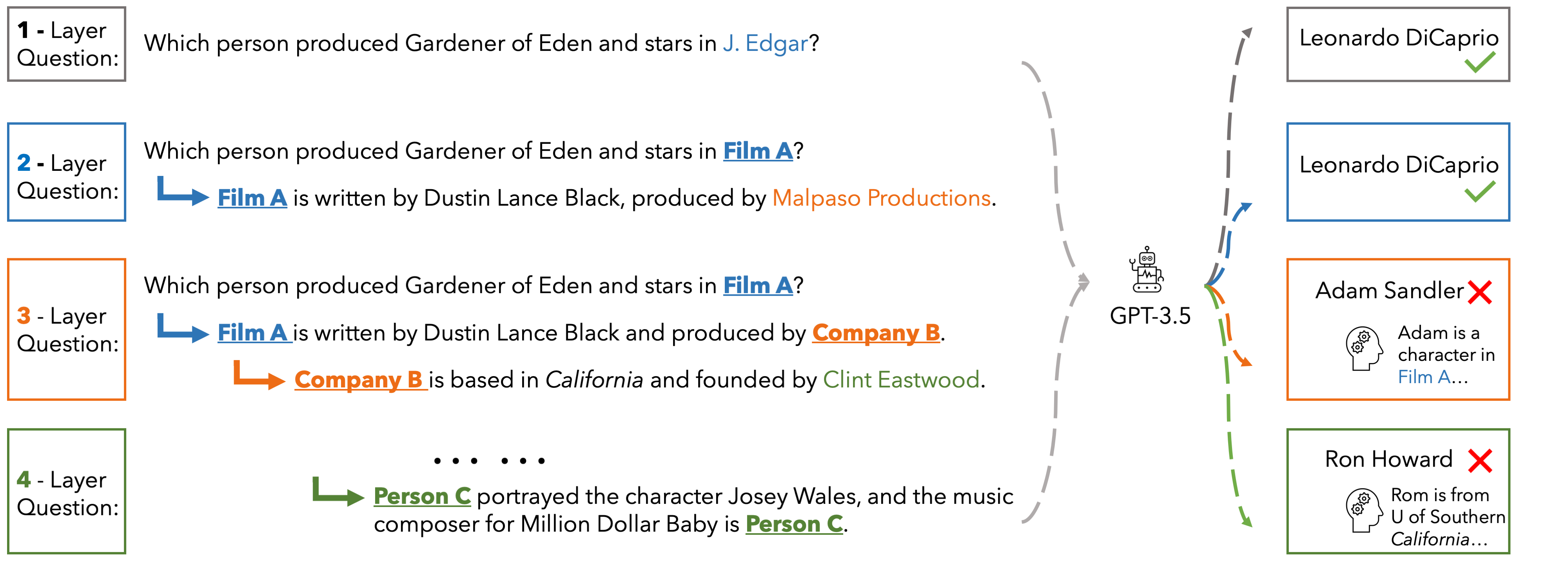
In EUREQA, every question is constructed through an implicit reasoning chain. The chain is constructed by parsing DBPedia. Each layer comprises three components: an entity, a fact about the entity, and a relation between the entity
and its counterpart from the next layer. The layers stack up to create chains with different depths of reasoning. We verbalize reasoning chains into natural sentences and anonymize the entity of each layer to create the question.
Questions can be solved layer by layer and each layer is guaranteed a unique answer. EUREQA is not a knowledge game: we adopt a knowledge filtering process that ensures that most LLMs have sufficient world knowledge to answer our questions.
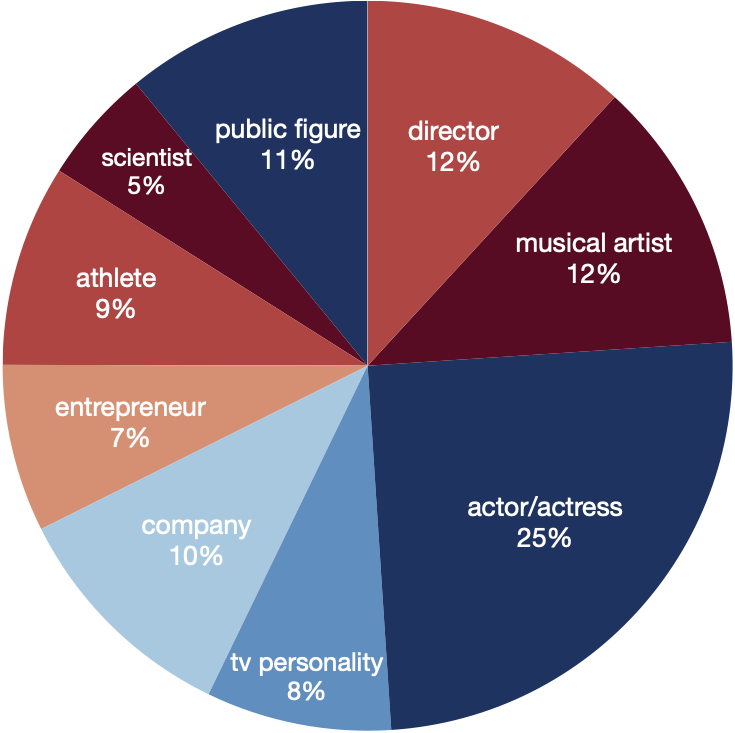
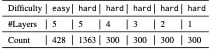
EUREQA comprises a total of 2,991 questions of different reasoning depths and difficulties. The entities encompass a broad spectrum of topics, effectively reducing any potential bias arising from specific entity categories.
These data are great for analyzing the reasoning processes of LLMs
This era birthed the (late 1970s to late 1980s). Directors like Adoor Gopalakrishnan ( Elippathayam , 1981) and G. Aravindan ( Thambu , 1978) created a parallel cinema that was uniquely, unapologetically Keralite. Elippathayam (The Rat Trap) is perhaps the definitive cinematic text of modern Kerala. It follows a feudal landlord, trapped in his decaying tharavadu , unable to adapt to a world where his tenants have rights and his nephews have moved to the Gulf. The film’s languid pace, the silence of the crumbling mansion, and the omnipresent rats are not just aesthetics; they are a metaphor for the death of an entire feudal culture.
: These actors are synonymous with Malayalam cinema, having delivered numerous iconic performances that have become ingrained in Kerala's cultural consciousness.
Kerala’s three major religions (Hinduism, Islam, Christianity) coexist with unique local practices ( Theyyam , Mappila Paattu , Margamkali ). Malayalam cinema often uses rituals as narrative devices.
: Kerala has a rich literary tradition, and many Malayalam films are adaptations of novels and short stories. This literary influence adds depth and complexity to the narratives.
 Analyses and discussion
This era birthed the (late 1970s to late 1980s). Directors like Adoor Gopalakrishnan ( Elippathayam , 1981) and G. Aravindan ( Thambu , 1978) created a parallel cinema that was uniquely, unapologetically Keralite. Elippathayam (The Rat Trap) is perhaps the definitive cinematic text of modern Kerala. It follows a feudal landlord, trapped in his decaying tharavadu , unable to adapt to a world where his tenants have rights and his nephews have moved to the Gulf. The film’s languid pace, the silence of the crumbling mansion, and the omnipresent rats are not just aesthetics; they are a metaphor for the death of an entire feudal culture.
: These actors are synonymous with Malayalam cinema, having delivered numerous iconic performances that have become ingrained in Kerala's cultural consciousness.
Kerala’s three major religions (Hinduism, Islam, Christianity) coexist with unique local practices ( Theyyam , Mappila Paattu , Margamkali ). Malayalam cinema often uses rituals as narrative devices.
: Kerala has a rich literary tradition, and many Malayalam films are adaptations of novels and short stories. This literary influence adds depth and complexity to the narratives.
This website is adapted from Nerfies, UniversalNER and LLaVA, licensed under a Creative Commons Attribution-ShareAlike 4.0 International License. We thank the LLaMA team for giving us access to their models.
Usage and License Notices: The data abd code is intended and licensed for research use only. They are also restricted to uses that follow the license agreement of LLaMA, ChatGPT, and the original dataset used in the benchmark. The dataset is CC BY NC 4.0 (allowing only non-commercial use) and models trained using the dataset should not be used outside of research purposes.